Start With the AI Answer
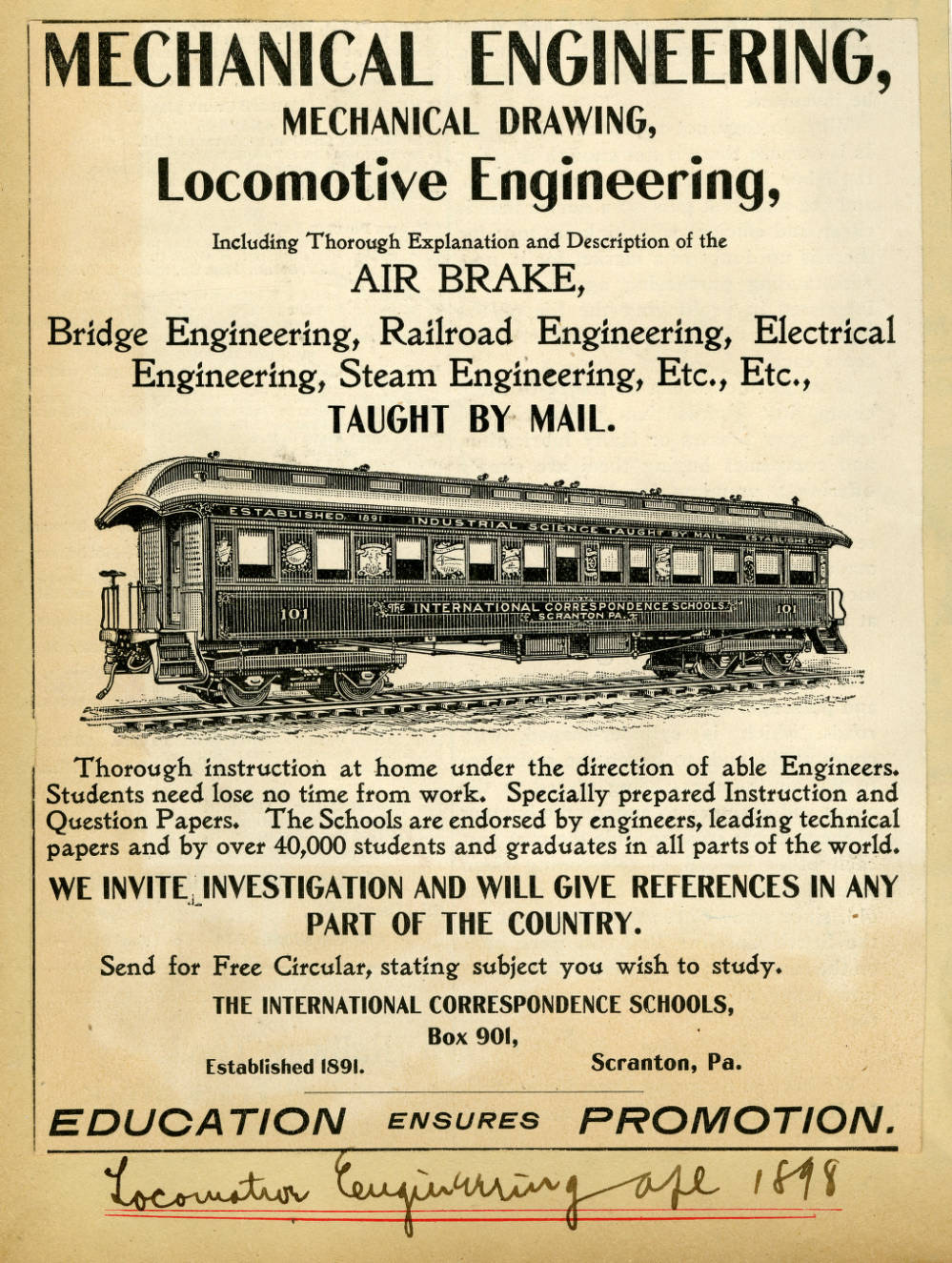
International Correspondence Schools advertisement, Locomotive Engineering, 1898. University of Scranton.
International Correspondence Schools advertisement, Locomotive Engineering, 1898. University of Scranton.
In a remote, asynchronous course, you never see students work. There’s no classroom, no discussion to overhear, no drafts taking shape. If an assignment can be done by pasting the prompt into a chatbot, some students will, and nothing will tell you. So in a compressed summer course on the history of diet and health, I tried starting there. The major assignments hand students the AI answer up front and ask them to do something with it: check it, complicate it, find what it missed. A few assignments go the other way and ask students to start from their own thinking, with AI allowed only for polish afterward.
I’m not sure the assignments are great yet. But the approach, meeting AI at the start instead of trying to keep it out, seemed worth recording.
Each assignment names its own relationship to AI. The course leans AI-first, with a few deliberate exceptions.
Start with AI output, then think on top of it:
Start with your own thinking:
From the course syllabus
Learning to use AI is an important skill in itself, but using it when you’re supposed to be working through the friction of thinking on your own is like bringing a forklift into the weight room.
Each assignment specifies the level and type of AI use that’s appropriate. Sometimes that’s not using it at all; sometimes the whole assignment is AI-driven. Please respect the intended AI component of each assignment, and clearly separate your work from AI’s work as asked.
One rule applies to every assignment: you must always differentiate your work from AI. If it even seems like vanilla AI (even if it isn’t), you will need to redo the assignment for credit.
It meets students where they already are. Online students will use AI; the only question is whether the assignment acknowledges it. Starting with AI output removes the temptation to pass it off as their own, because the output is already on the table. What earns credit is the layer on top: checking claims against the reading, spotting what the answer flattened, bringing course material to bear on it.
The critical thinking still happens, even if students aren’t writing everything out themselves. Many of the assignments ask for specific moves (one claim verified, one corrected, one passage understood better, one place the original complicated the AI) that are hard to do without engaging with the sources.
The no-AI assignments keep the other half of the skill alive. Reflections are where students practice turning reading into their own interpretation, and the final reflection asks about an experience only they had. Putting both kinds side by side shows students that AI’s role depends on what an assignment is for.
AI can do the critique layer too. A student can ask AI to find the flaws in AI’s answer and paste the result. The strongest defense is requiring specifics from the actual sources (quoted passages, page-level details, course readings by name), which a generic critique can’t supply.
Whether the critique students wrote was really theirs, and how I’d know. Whether starting with AI output anchors students to its framing more than it frees them from it. And whether the balance was right: an online course may need more no-AI practice early on, before students are asked to critique AI’s version of a reading they haven’t wrestled with themselves.
This sketch is licensed under Creative Commons BY-NC-SA 4.0. You're welcome to share and adapt it for noncommercial purposes, with credit, as long as you share your adaptation under the same license.
Image International Correspondence Schools advertisement, Locomotive Engineering, 1898. University of Scranton. The image's own license applies to it, separately from the sketch.
Suggested citation
Fred Gibbs. "Start With the AI Answer." AI Sketchbook, Amaranth, University of New Mexico, September 25, 2026. https://amaranth.unm.edu/ai-sketchbook/policy/start-with-the-ai-answer.html. Licensed under CC BY-NC-SA 4.0.