Disruptive Expertise
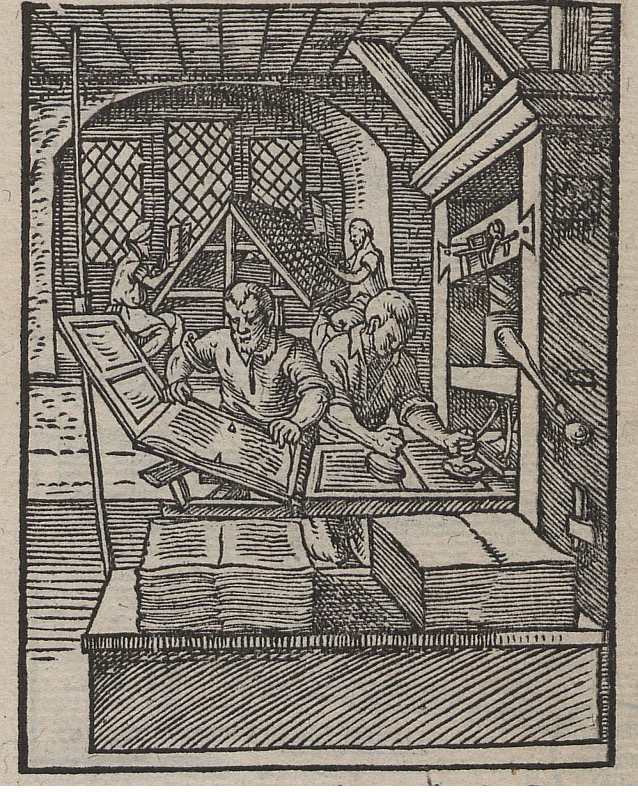
Jost Amman, Der Buchdrucker (The Printer), woodcut from the Ständebuch, 1568. Deutsche Fotothek.
Jost Amman, Der Buchdrucker (The Printer), woodcut from the Ständebuch, 1568. Deutsche Fotothek.
When printing arrived in Europe, critics worried about a flood of bad books. The telegraph raised fears about rumors spreading at the speed of wire; radio, about mass manipulation. Sound familiar? Each student takes one of those earlier moments and writes a short case study: what the technology was, what people hoped and feared, and what happened next. They research with plenty of AI help, but every claim gets checked against real sources. Together, the case studies become a public website that traces the pattern across centuries.
Assign technologies, not topics. The printing press, the telegraph, photography, radio, television, photocopying, personal computers, search engines, social media. Students usually start knowing almost nothing about theirs, and that’s useful: they learn how to get oriented in an unfamiliar period with AI’s help, and where that help runs out.
The page has five required parts:
Then one more section: what might be lost. Each page ends with an account of how the student used AI in research and writing, and what AI-assisted research tends to miss: which nuances, which sources, and how leaning on AI changed the process.
Scaffold the research in class. In a sources workshop, students gather and filter about twenty relevant sources into a source-grounded tool like NotebookLM and use it to sketch a preliminary narrative. Then a general chatbot becomes a sounding board: support the thesis, challenge it, find counterevidence and missing perspectives. Point out the difference between the grounded tool and the general one.
Build in checkpoints. Drafts go live on the site before a round of lightning presentations (topic, sources, how students steered AI, what’s still uncertain). Each student then writes a short peer review of a classmate’s page (coherence, sourcing, the AI connection, honest documentation of AI use) before submitting the final version.
Publish it. In my version, students each fork a shared GitHub repository, build their page in their own copy, and submit it through a pull request, so nobody can break anyone else’s work. Any shared publishing platform would do; the public audience is what matters.
Research prompts vary by student. Paired with a set of gathered sources, these do the most work:
prompts for the sources workshop
What perspectives are missing from this account? What sources would I need to find to tell a fuller story? What historical context is missing but useful? What do we NOT know about this topic, and why?
Students arrive with strong opinions about whether AI is making us dumber. The project sends them to find out how the same fear played out with print or television, and whether it came true. Readings arguing that trust in a new medium has to be built, like Adrian Johns on print, tell them what to look for.
The research doubles as the lesson about AI. An unfamiliar technology is exactly where AI is most tempting and least trustworthy: quick at orientation, fluent about context, unreliable about specific evidence and quotations. The verified primary source and the closing section on what might be lost make students notice that in their own work.
The shared site gives each essay a reason to exist. Each page is small; together they reveal a pattern no single student could have found, which is a nice model of how knowledge gets built.
The peer review criteria double as a grading checklist, which means students have seen the standard twice before the final version.
The AI connection section tends to be generic (‘AI is also a disruptive technology that challenges expertise’). Ask for a specific parallel, and a specific difference, grounded in the case the student just researched.
This sketch is licensed under Creative Commons BY-NC-SA 4.0. You're welcome to share and adapt it for noncommercial purposes, with credit, as long as you share your adaptation under the same license.
Image Jost Amman, Der Buchdrucker (The Printer), woodcut from the Ständebuch, 1568. Deutsche Fotothek. The image's own license applies to it, separately from the sketch.
Suggested citation
Fred Gibbs. "Disruptive Expertise." AI Sketchbook, Amaranth, University of New Mexico, September 25, 2026. https://amaranth.unm.edu/ai-sketchbook/teaching/disruptive-expertise.html. Licensed under CC BY-NC-SA 4.0.