Take the AI Draft to the Archive
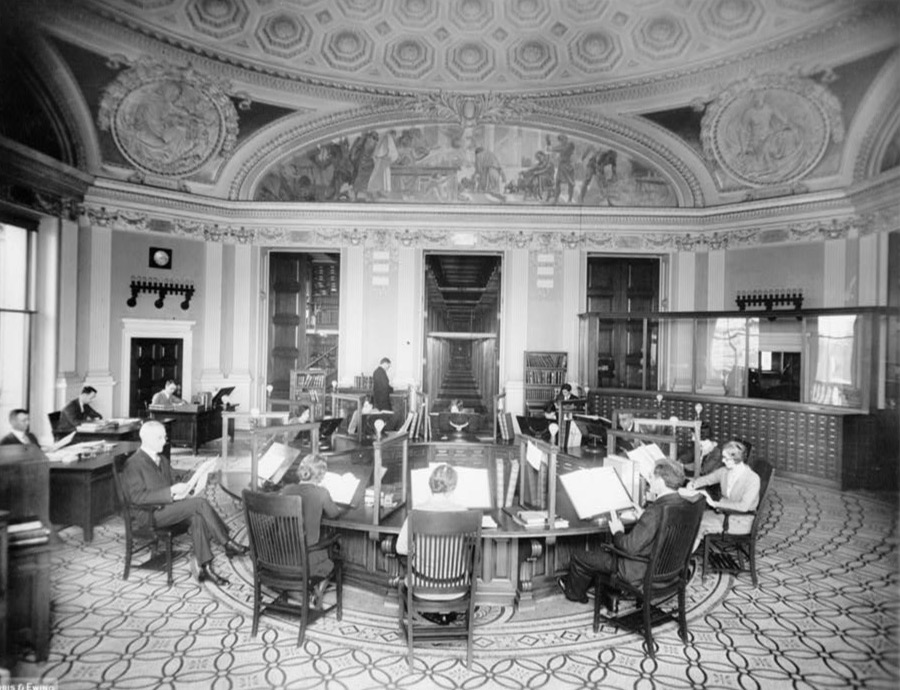
Harris & Ewing, The Manuscript Division in the Library of Congress, c. 1930s. Library of Congress.
Harris & Ewing, The Manuscript Division in the Library of Congress, c. 1930s. Library of Congress.
Most assignments that pit AI against “real research” check the model against a book or a website, which mostly tests how well it summarizes. This one sends students somewhere the model has never been. They ask AI for a short history of a narrow topic, pick it apart, then carry that draft into a physical collection of letters, minutes, clippings, photographs, and planning files to find out what the record says. The final essay fuses both and has to account for every difference.
The project runs in two parts, with a class discussion in between.
Pick a topic that is narrow, local, and held somewhere. A building, an organization, a protest, a local business, a neighborhood institution, a person who mattered to one place. The sweet spot is a topic the internet has barely touched but a nearby collection holds in boxes: university special collections, a local historical society, county records, a church or company archive. Broad topics fail both ways: the AI draft is competent and the archive is overwhelming. A shared sign-up sheet keeps topics from doubling up.
Part 1: generate and critique. Students prompt for a ~600-word history, asking for specific dates, people, and sources, and save the response unedited. That draft is the baseline for everything that follows. Then they write a short critique (3–5 sentences) quoting one passage that seems reliable and one that seems suspicious or thin, and explaining why. Just as valuable is the byproduct: a list of specific claims to check. Drafts and critiques go up before class, and the discussion compares how differently the model handled different topics.
Part 2: the archive. Students bring their list of claims to the reading room. Published histories are fine for orientation, but the assignment asks for unpublished material: manuscript boxes, not just the reference shelf. An archivist is the best guide here, so let them know what students are looking for.
Write the real essay. Students reshape the AI draft into a short public-facing history (~800–1000 words) built on what they found, with scanned images, captions that say why each item matters, and citations precise enough (collection, box, folder) that a reader could find the same document.
The required comparison section. The essay ends with an AI–Archive Comparison that quotes the original draft and sorts its claims: confirmed, contradicted, or simply absent from the record. Then the reverse question: what did the archive contain that the AI draft never mentioned, and why couldn’t it have?
prompt to give students
Write a short history (~600 words) of [your topic]. Include specific dates, events, people, and sources where possible.
The prompt is deliberately plain. Asking for specifics and sources pushes the model toward claims that can be checked, and toward citations that may or may not exist.
Check AI against published or digitized sources and it all comes down to accuracy (did it get the date right?), and the models keep getting better at that. Unpublished material changes the question from accuracy to access. The letters, minutes, and photographs in a manuscript box were never in any training set. When the draft is silent or generic where the box is rich, students are looking at a structural limit that no better prompt could fix.
Part 1 forces a close reading before a verdict. Students have to decide what in the AI draft is checkable, what only sounds specific, and what could describe almost any topic with a few nouns swapped. That list of claims turns an archive visit from browsing into an investigation.
The best essays notice that it cuts both ways. The archive is no neutral corrective to AI; it reflects someone’s decisions about what was worth keeping, how to catalog it, and what to call it. A student who finds the gap in the box (the group that left no records, the meeting with no minutes) has learned the AI draft’s lesson from the other direction.
Grade each part on engagement, not on whether the AI draft turned out to be accurate or the archive turned out to be rich.
The critique (Part 1)
The essay (Part 2)
Check with the collection before you assign it. Confirm that there are materials on the likely topics, that the reading room can handle a class’s worth of requests, and what the rules are — pencils only, lockers, retrieval times, scanning. An archivist who knows students are coming is an enormous help.
This sketch is licensed under Creative Commons BY-NC-SA 4.0. You're welcome to share and adapt it for noncommercial purposes, with credit, as long as you share your adaptation under the same license.
Image Harris & Ewing, The Manuscript Division in the Library of Congress, c. 1930s. Library of Congress. The image's own license applies to it, separately from the sketch.
Suggested citation
Fred Gibbs. "Take the AI Draft to the Archive." AI Sketchbook, Amaranth, University of New Mexico, September 25, 2026. https://amaranth.unm.edu/ai-sketchbook/teaching/ai-draft-archive-check.html. Licensed under CC BY-NC-SA 4.0.