Jackson Andress
The Venetian Paper Industry
Venice, Paper, and Printing
The advent of the printing press fundamentally and radically changed European society as it fostered large increases in literacy and access to information. However, this remarkable innovation was not able to thrive on its own, it required another key innovation originally developed in China: paper. In 1468, printer Jacob of Speyer established his press in the city of Venice in large part because Venice had access to large quantities of paper due to their development of the paper industry in the nearby area surrounding the beautiful alpine Lake Garda. Subsequent printers like Aldus Manutius also made use of Venice’s access to paper and, by the 1480s, Venice had become the leading city for printing in all of Europe and the world.
Humanism and Manuscripts
Some of the most popular texts printed in this time were editions of key texts by classical Greek and Roman authors like Plato, Livy, Cicero, Pliny, and more that were highly venerated by the humanist intellectuals of the Italian Renaissance. This woodblock printing on paper of an historiated initial “I” may have been part of such a classical text, though the scholars at the Victoria & Albert Museum where it is kept are unsure where the initial came from or who printed it. Their collection, which was gathered from an early 20th century collection assembled by British art historian Oscar Jennings, features other historiated initials known to have been printed by German-Venetian printer Erhard Ratdolt, so it is possible that this initial was also produced by Ratdolt.
His Qui Diligunt
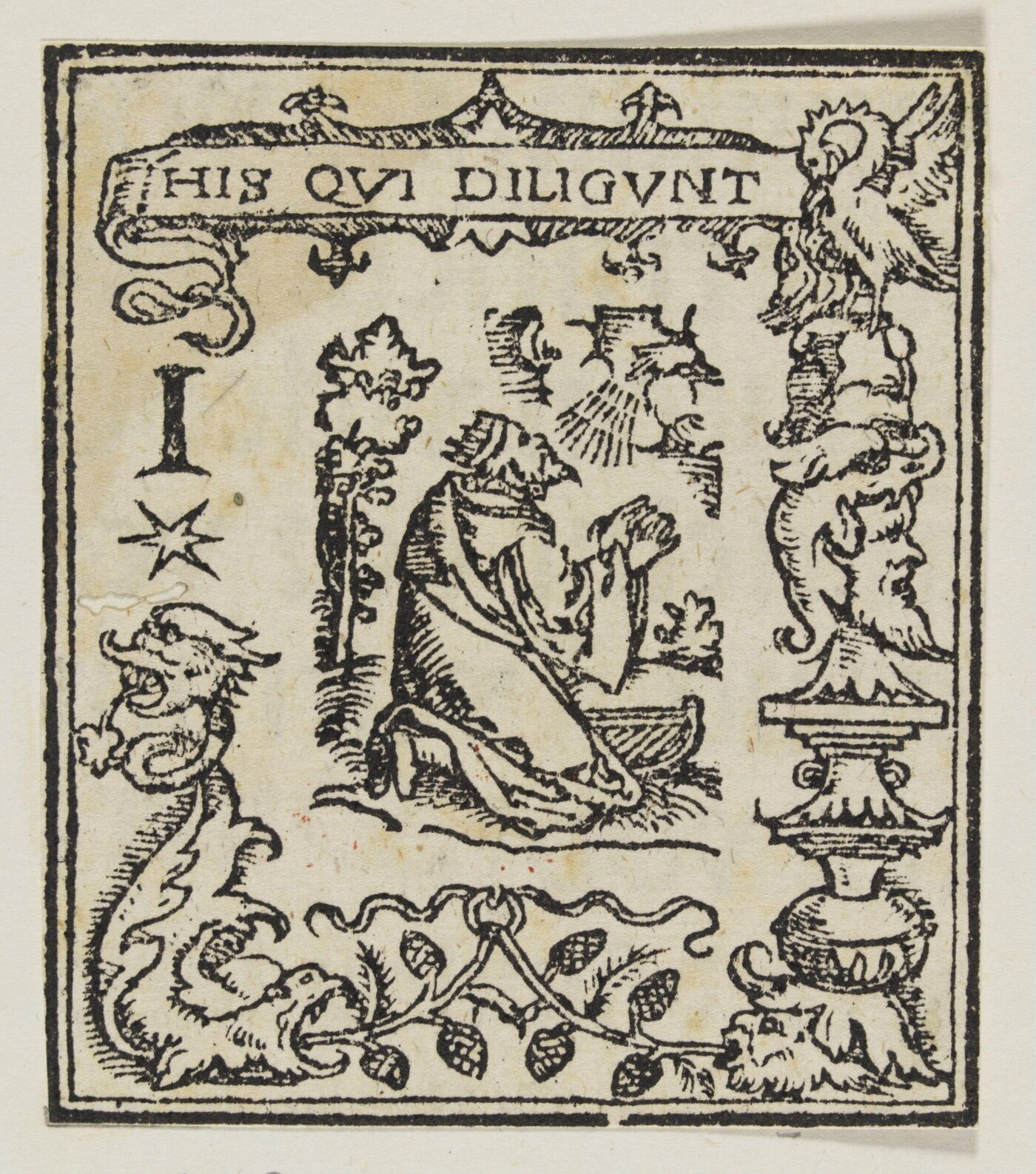
Unknown. Printed Historiated Initial “I.” c. Late 15th century. Wood cut printed on paper, 380 mm. x 266 mm. Victoria and Albert Museum, London.
Nonetheless, it features the Latin phrase “His qui diligunt” meaning “To those who love,” a phrase often associated with the Biblical passage in Romans 8:28 remarking upon “those who love Him” (God). As such, it is possible this initial came from a printed edition of the Bible, which were also very popular in the Late Middle Ages and Early Modern Period. This period of Venetian printing saw Latin and Greek language texts printed at very high rates and being disseminated across the Venetian Republic and beyond.
Editio Princeps and Historiated Initials

Incipit page from the editio princeps of Pliny’s Historia naturalis, 1469, Printed by Jacob of Speyer, Venice.
Though not nearly as revered as in the Early Modern Period, these editio princeps or first editions were the basis for the scholarly study of classical texts for centuries before the advent of the field of textual criticism in the 19th century which led to the rebuking of these editions as inaccurate to the classical or ancient originals. However, these texts were highly sought after for centuries by Late Medieval and Early Modern humanists and later scholars of the Enlightenment. The historiated initials of these texts continued to be of interest to art historians like Jennings whose vast collection of decorated and historiated initials proves invaluable to the modern study of medieval manuscripts.
Conclusions: Paper, Printing, and Power
The paper industry of Venice was a vital element to their conquering of the printing industry in the late 15th and early 16th centuries. Having their own homegrown paper industry allowed the Venetians to more cheaply produce texts while their already established networks of trade and circulation allowed them to disseminate these texts widely and quickly. However, the Venetians and indeed Europeans at large would not have been able to develop a printing industry if not for the Chinese invention of paper in the first place, demonstrating yet another way that Venice benefitted from the creation of their own versions of Chinese industries.
Bibliography
- Hannawi, Abdul Ahad. “The Role of the Arabs in the Introduction of Paper into Europe.” MELA Notes 85 (2012): 14-29.
- Nuovo, Angela. The Book Trade in the Italian Renaissance. Brill, 2013.