student name
Sogdian-language Letter
Medieval Manichaean Book Art
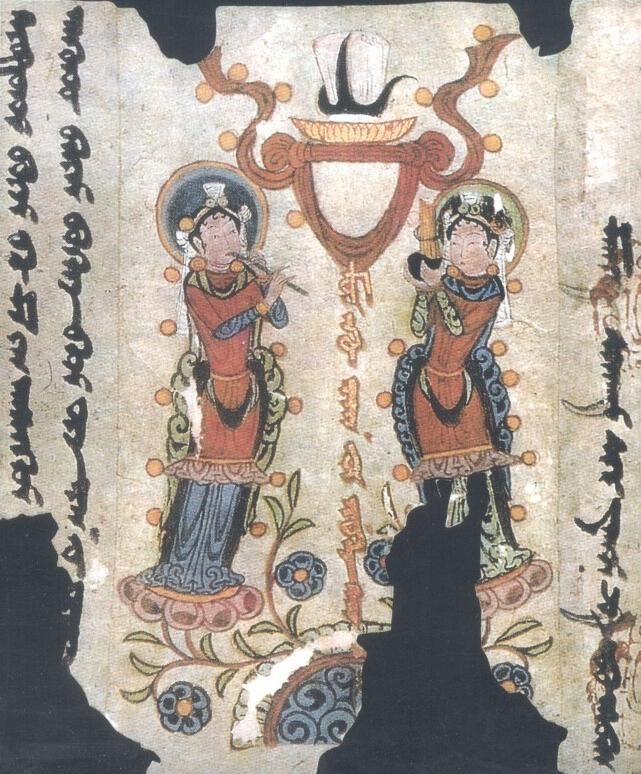
Mediaeval Manichaean Book Art: A Codicological Study of Iranian and Turkic Illuminated Book Fragments from 8th–11th Century East Central Asia is a book by Zsuzsanna Gulácsi that analyzes and compares multiple surviving artifacts of Manichaean script. One of these artifcats is a Sogdian-language letter, written by Shahryâr Zâdag to Bishop Mu Wei, notable for its depiction of two ‘deities’ or angels of music. The letter was found in the Bezeklik Thousand Buddha Caves, in Xinjiang, China. It is categorized as 81 TB 65 by the Turpan Museum, where it is housed today.
The Figures and Script
](/silk-road//objects/sogdianletter/images/letter2.jpg)
The deities of music. Source

](/silk-road//objects/sogdianletter/images/letter1.jpg)
The deities of music. Source

The letter is composed of nine pieces of paper glued together, all written in Sogdian. There is a vermilion seal on the paper adhesion and the bottom line, and there is an illustration in the middle of the upper line, depicting a pair of beautifully dressed figures wearing a scarf and crown, one blue and one green halo. These have been interpreted to be gods or angels of music. Between these divine beings of music, there is a Sogdian “Glory of Mucha” with gold leaf which has become the most eye-catching and unique symbol of the letter. Above the golden halo is a white hat crown exclusively for the Bishop, leader of the Elect. It is on a gold plate, which is placed on a red shawl floating in the air.1 There is a circular pool below the title, in which the fragrant flowers are in full bloom, and the flower core just holds up the two gods. According to Prof. Yutaka Yoshida, this letter shows the “latest” stage of the Sogdian language, in which some new words unknown to scholars were found. These letters provide evidence of the patronage the Uyghur Khaganate’s court had for not only Buddhism, but also Manichaeism, where it must have flourished for a time.2 In the case of the latter, it was actually formally adopted by the ruler of the Khaganate, though its status varied under his successors, before losing all state patronage a few decades later.3 It was not until the Yuan Dynasty that Manichaeism gained legal (but not favored) status. Nevertheless, these few years of legitimacy were enough for adherents to leave a multitude of letters, murals, scriptures and paintings in the area, many found in the sealed majority-Buddhist caves of Dunhuang and Bezeklik.
Bibliography
- Gulácsi, Zsuzsanna. Mediaeval Manichaean Book Art: A Codicological Study of Iranian and Turkic Illuminated Book Fragments from 8th–11th Century East Central Asia. Leiden: Brill, 2005.
- Yoshida, Yutaka. “Conférence de M. Yutaka Yoshida : Manichaean Sogdian Letters Discovered in Bāzāklik.” Annuaire de l’École pratique des hautes études, Section des sciences religieuses 109 (2000–2001): 233–236..
- Moriyasu, Takao. “New Developments in the History of East Uighur Manichaeism” Open Theology, vol. 1, no. 1.