B Vigil
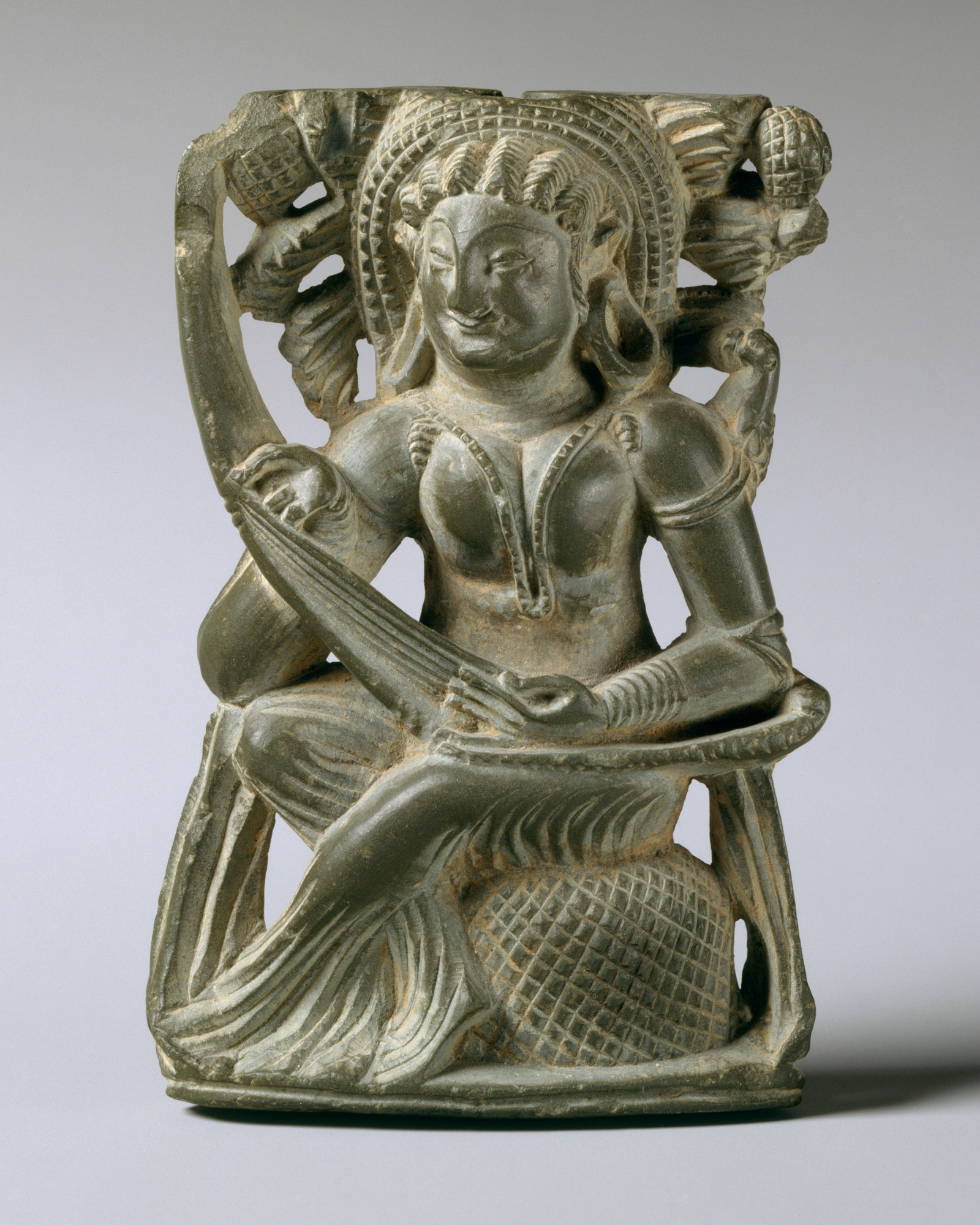
Mirror Handle with a Woman Playing the Lute
Mirror Handle from Jammu and Kashmir
](https://images.metmuseum.org/CRDImages/as/original/DT8673.jpg)
Mirror Handle with a Woman Playing the Lute Source
This mirror handle is from India in the 6th or 7th century. It is made of cholite schist, a type of rock that has a dull green shade as seen in the image. There are a few similar objects depicting presumably high class women in leisurely positions. These were also likely luxury goods.1
This mirror handle, being a luxury good, depicts a woman who is likely upper class. This is a reasonable estimate due to her having leisure time, as well as women likely wanting to see themselves depicted in an object they would use frequently. Her outfit also has a significant amount of detail, suggesting her clothing to be well made. Though we cannot tell exactly what type of cloth she is wearing, rough estimates can be made. According to Lola Davidson’s article ‘Woven Webs: Trading Textiles around the Indian Ocean’, “Women wove cotton, raffia and indigenous silk into a warp-striped clothcalled a lamba which was used as either a skirt or a shawl.”2
Trade and How This Item May Connect
There is also what appears to be beading on her outfit, specifically on the top. Due to it’s proximity and the important exchange between India and Sri Lanka, it can be assumed that this is gemstones or ivory of some kind. In Sri Lanka, Davidson states “All cloth for the traditional dress of sarong and sash was imported from India in exchange for Sri Lanka’s exports of gemstones, rare woods, ivory, elephants and cinnamon.”2 With the importance of trade between Sri Lanka and India, due to Sri Lanka’s lack of indiginous cloth agriculture in the 1st to 4th century, this exchange would have been frequent. If a woman is of high status, it is natural to assume that if she is decorated with gems, they could be the ones from Sri Lanka.
Bibliography
-
Mirror Handle with a Woman Playing the Lute, 6th-7th Century, Sculpture, The Met Fifth Avenue, Gallery 237, accessed March 11, 2026, https://www.metmuseum.org/art/collection/search/38424.
-
Davidson, Lola Sharon. “Woven Webs: Trading Textiles around the Indian Ocean.” PORTAL Journal of Multidisciplinary International Studies 9, no. 1 (June 6, 2012). https://doi.org/10.5130/portal.v9i1.2562.
-
Mirror Handle with a Woman Playing the Lute, 6th-7th Century, Sculpture, The Met Fifth Avenue, Gallery 237, accessed March 11, 2026, https://www.metmuseum.org/art/collection/search/38424. ↩
-
Davidson, “Woven Webs: Trading Textiles around the Indian Ocean,” PORTAL Journal of Multidisciplinary International Studies ↩ ↩2