Meg Lambert-Malins
Khan al-Umdan: An Ottoman Port Khan in Acre
Khan al-Umdan: An Ottoman Port Khan in Acre
Introduction
Khan al-Umdan stands in the south-east corner of the old city of Acre, directly by the port, and is the largest and best-preserved Ottoman khan in the region. Unlike the rural fortress-like caravanserais of Khurasan, Khan al-Umdan is an urban institution: its daily work was not to shelter long-distance caravans crossing open country, but to serve the ordinary commercial life of a working Mediterranean port. Two storeys of arcaded galleries enclose a large rectangular courtyard, built directly on the foundations of a Crusader-era royal customs house.1 The building represents a later and quite different moment in Islamic hostelry architecture than Ribat-i Sharaf, one shaped by Ottoman port urbanism rather than by the demands of the Silk Road caravan economy.
Architecture and Plan
Khan al-Umdan is a two-storey structure arranged around a rectangular courtyard enclosed by two tiers of arcades—the lower arcade resting on red and black granite columns, from which the building takes its name (al-umdan meaning “the pillars”).2 Petersen describes three entrances: the main gate on the north side, with two additional gateways on the south. Above the main north gate rises a square clock tower built at the turn of the twentieth century to commemorate the silver jubilee of Sultan Abdul Hamid II, a later addition that gives the building its most distinctive silhouette against the Acre skyline.3
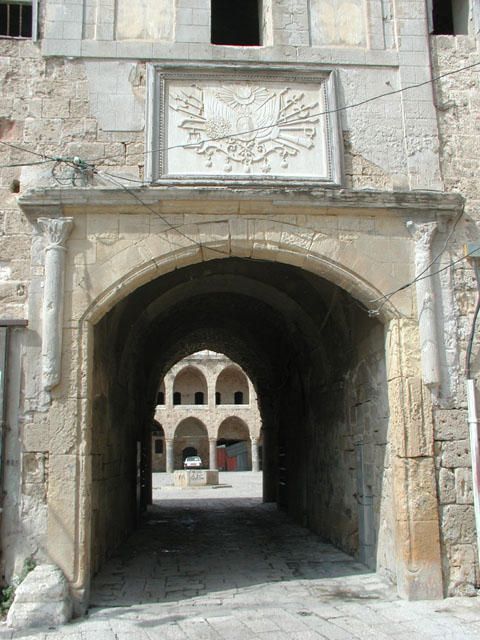
View through the main gate into the courtyard, showing the deep vaulted entrance passage. Photograph by Noa Havilio, courtesy of Archnet.
In 1943, the British archaeologist R. W. Hamilton inspected the khan and recorded its condition. His observations, preserved in the Palestine Archaeological Museum archives, describe the colonnaded gallery behind the arcade as containing “a range of big barrel-vaults with high windows in the back wall,” with masonry-vaulted stairs leading from the courtyard to the upper floor. The rooms on the upper gallery are small barrel-vaults, and at the southeast corner an L-shaped passage leads to latrines built into the sea wall—a reminder that the building’s eastern side opens directly onto the Mediterranean.4
Urban Context and Function
As an urban khan in a Mediterranean port city, Khan al-Umdan served a different commercial ecology than the isolated rural caravanserais of Iran. Constable’s analysis of medieval Muslim hostelry architecture emphasizes that in the Levant and Syria, the word khan had become the dominant term for urban commercial lodging, distinct from the Mediterranean funduq further west and the rural Persian caravanserai further east.5 The khans of the Levantine coast, unlike their Khurasani counterparts, were not fortified monuments on empty landscapes but integrated commercial buildings embedded within the daily fabric of port cities—storage space for incoming and outgoing cargo, lodging for visiting merchants, and sometimes locked facilities used by urban authorities for short-term confinement of travelers.
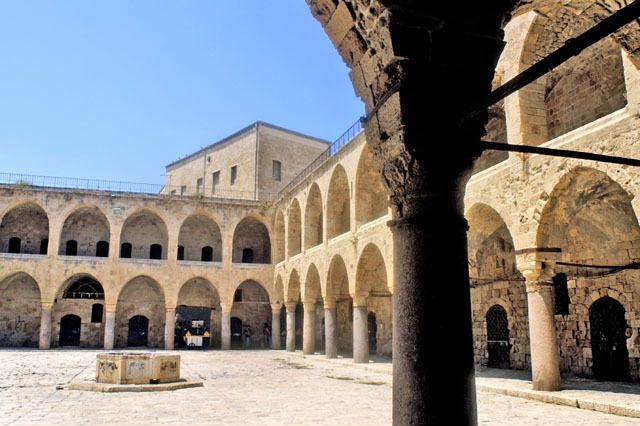
Interior view of the courtyard, looking across the lower arcade toward the upper gallery. Photograph by Maureen Ruddy-Burkhart, 2006, courtesy of maureenruddyburkhart.com and Archnet.
Khan al-Umdan’s port-adjacent location made it well suited to the movement of goods across the harbor. Ships arriving at Acre’s harbor could unload cargo directly into the khan’s ground-floor vaulted chambers; merchants could lodge on the upper floor while conducting negotiations or waiting for their goods to be weighed, taxed, and released. This integration of storage, lodging, and commercial transaction within a single building was, as Constable observes, the defining feature of the medieval Islamic commercial hostelry—not an innovation at Acre, but an institutional pattern with origins stretching back through the Byzantine pandocheion and the early Islamic funduq.6
Building History
The site has a layered history going back to the Crusader period. The archaeologist Denys Pringle’s work on Acre identifies the foundations beneath Khan al-Umdan as those of the Royal Customs House of the Crusader Kingdom of Jerusalem—a building that would have served much the same commercial function.7 The Ottoman khan that now stands was built in the late eighteenth century, typically attributed to the reign of Ahmed Pasha al-Jazzar, the Ottoman governor of Sidon (1775–1804), who undertook extensive rebuilding of Acre after its capture by the Ottomans.8 The continuity of commercial function across nearly six centuries—Crusader customs house, Ottoman khan, modern heritage site—demonstrates how central the port economy remained to Acre’s identity across multiple political regimes.
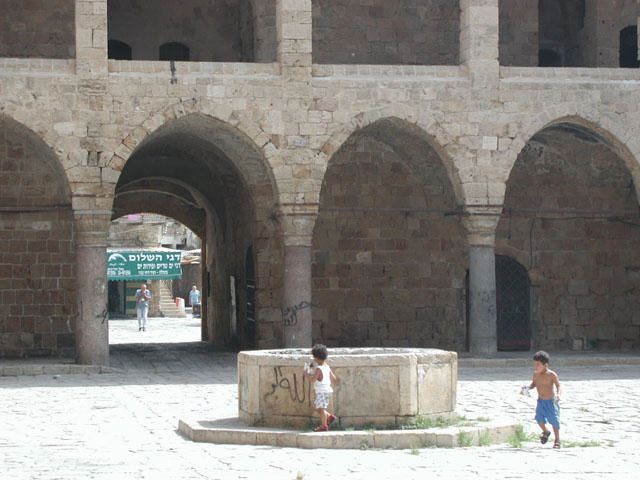
The fountain (sabil) in the courtyard of Khan al-Umdan, with the lower arcade visible in the background. Photograph by Noa Havilio, 2002, courtesy of Archnet.
Significance
Khan al-Umdan stands as a signature example of Ottoman commercial architecture in the eastern Mediterranean and an important surviving piece of Acre’s late Ottoman port economy. Its two-tier arcade, granite columns, and integrated water supply through the courtyard sabil mark it as an urban khan of substantial scale and architectural ambition, even as it functioned as a working commercial facility rather than a royal monument. Compared to the fortified isolation of Ribat-i Sharaf, Khan al-Umdan illustrates how the same typological vocabulary—courtyard, arcade, central water source, gated enclosure—could be adapted to radically different commercial environments across the Islamic world.
Image Credits
Header image, main gate, and fountain photographs: Noa Havilio. Source: Archnet.
Courtyard photograph: Maureen Ruddy-Burkhart (2006). Source: maureenruddyburkhart.com and Archnet.
-
Andrew Petersen, A Gazetteer of Buildings in Muslim Palestine, Part 1, British Academy Monographs in Archaeology 12 (Oxford University Press, 2001), 87. ↩
-
Petersen, Gazetteer, 87. ↩
-
Petersen, Gazetteer, 87–88. ↩
-
Petersen, Gazetteer, 87, citing R. W. Hamilton’s 1943 field notes (PAM Hamilton 9.11.43). ↩
-
Olivia Remie Constable, Housing the Stranger in the Mediterranean World: Lodging, Trade, and Travel in Late Antiquity and the Middle Ages (Cambridge University Press, 2003), 59–61. ↩
-
Constable, Housing the Stranger, 40–42, 88–90. ↩
-
Petersen, Gazetteer, 87, citing Denys Pringle, Secular Buildings in the Crusader Kingdom of Jerusalem: An Archaeological Gazetteer (Cambridge University Press, 1997), 15–17. ↩
-
Archnet entry for Khan al-Umdan, https://www.archnet.org/sites/3490. ↩