Rebecca Brach
Coral and Carnelian Adornment at Ilibalyk, Kazakhstan
Ilibalyk, Kazakhstan
The medieval city of Ilibalyk in modern day Kazakhstan was occupied from the 10th to 15th centuries, spanning the rise and fall of the Mongol Empire. The necropolis which has been excavated over the course of ten field seasons, appears, thus far, to have a more limited period of use from approximately the 12th to 14th centuries, based on dated coins found within burials. This site is an example of a place of trade and occupation functioning within the Mongolian Empire, and later the Chagatai Khanate 1
The necropolis offers a window into the lives, beliefs, and culture of the occupants of the site. In particular, the majority of burials investigated thus far have cultural and stylistic markers of the Christian Church of the East, or Nestorian Christianity. Thus, the graveyard and associated finds offer a unique window into the relationship between religion and cultural identity within the wider empire. While the necropolis is limited to a subset of the population, the nearby Shahristan and city wall offer a broader view of the site’s usage and role within the region. All of this cannot be disconnected from the city’s position within the Mongol Empire and along a known trade route. The movement of peoples and goods brought by the Silk Roads would certainly have greatly impacted the lives and understandings of the more permanent inhabitants of Ilibalyk.
As a firmly landlocked region, the presence of coral and other exotic goods evidence far-reaching trade relationships.
In both graves in which coral has been found, it has always been in association with carnelian, and significant additional grave goods have been found. In addition, a small horde was found within the Shahristan containing one coral and two carnelian necklaces. This frequent association and presence of additional prestige goods makes coral a unique perspective from which to examine the people of ancient Ilibalyk.
In the Necropolis
](/silk-road//essays/coral-and-carnelian/images/fragment-and-rings.png)
Beads of a bracelet and rings found in a grave. Source
Two graves thus far have yielded coral. Both graves were of women estimated to be middle aged, one of whom was in her final trimester of pregnancy. Additional grave goods were found with both women.
At least two rings were found in each woman’s grave. One was buried with a pair of scissors, and the other with pearled earrings. Although not common, scissors have become a regular find at Ilibalyk and have been noted in both male and female graves throughout the Mongolian Empire 1 Pearls, on the other hand, are well known as widely traded prestige goods throughout the Mongol Empire. Their beauty, natural luminescence, and association with healing properties is well documented 2. Unlike such examples as the gold Roman earrings 3, these were not designed for pierced ears, instead wrapping over the top. This may be due to the weight of the materials and quantity of pearls.
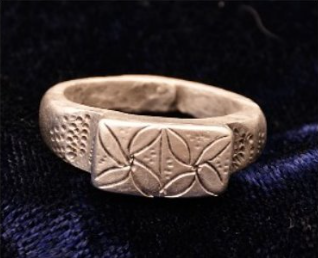
Alongside the pearl earrings and elaborate bracelets of coral, carnelian and other materials, the woman buried in one of these grave was wearing two additional silver bracelets, three silver rings, and one gold ring set with a green turquoise. Of these adornments, nearly all bear some form of religious imagery, primarily that of a four-leaf rosette. This symbol is known to have been used by Christians as a hidden image of the cross 4.
Additional Jewelry Found in Burial



In the Shahristan
The shahristan was a hub for the medieval city of Ilibalyk. Near the city walls to the north and east of the city, excavation were done revealing a bathhouse, among other structural finds. In addition to these, a literal treasure box was found in a niche of the fortress wall 1. Within this box, among other stunning finds, was a coral necklace, and two necklaces of dark carnelian beads.
](/silk-road//essays/coral-and-carnelian/images/carnelian-necklace.png)
Reconstructed carnelian necklace. Source
](/silk-road//essays/coral-and-carnelian/images/carnelian-beads.jpg)
Another carnelian necklace. Source
The shahristan is certainly representative of a different realm of identity and existence for the people living at Ilibalyk than the cemetery. Nevertheles, the similarty in materials found here with those in the necropolis demonstrates the integration of religious and cultural identity. The burial styles are Christian: all individuals are buried facing the east, the rising sun. Many of them are buried with religious symbols such as the four-petal rosette, or cross-engraved gravestones not discussed here. They are also buried with culturally identifying artifacts such as scissors, or boqta headdresses briefly discussed under ‘Bracelet with Coral and Carnelian’. The people of Ilibalyk lived at a point of integration between their cultural and religious practices, alongside exotic and beautiful goods made available to them through the globalized network of trade which connected them to the rest of the Empire.
The presence of these exotic materials of coral and carnelian is further significant for what it reveals about the people of Ilibalyk’s understanding of themsesleves and their place in the world. Possessing a maritime material such as coral connected the owner to a place they likely never saw in their lives: the ocean. As is seen with objects from the Tang dynasty depicting women and dress, 5 and many other women featured in ancient art, their adornment was a means of identity and self expression. Coral demonstrated a connection and owneership over the exotic; the rich colors of the carnelian would certainly have been eye catching in their desert environment. Adornment at Ilibalyk was a means of self expression, cultural identity, and an expression of the city’s place along the Silk Road.
Bibliography
- Allsen, Thomas. 2019. The Steppe and the Sea: Pearls in the Mongol Empire. Encounters with Asia. University of Pennsylvania Press.
- Eurasia Exploration Society, Switzerland, International Institute for Central Asian Studies, Archaeological Expertise LLP, Kazakhstan, and Tandy Institute for Archaeology. 2019. “Field Report on the Archaeological Excavations at Usharal-Ilibalyk, Kazakhstan in 2019.” Society for the Exploration of Eurasia. https://www.exploration-eurasia.com/inhalt_english/frameset_projekt_aC.html.
- Society for the Exploration of Eurasia, Switzerland, International Institute for Central Asian Studies, Archaeological Expertise LLP, Kazakhstan, and Lanier Center for Archaeology, USA. 2023. “Field Report on the Archaeological Excavations at Ilibalyk Site (Medieval Christian Necropolis), Kazakhstan in 2023.” Society for the Exploration of Eurasia, Society for the Exploration of Eurasia. https://www.exploration-eurasia.com/inhalt_english/frameset_projekt_aC.html.
- Stewart, Charles Anthony. 2020. “The Four-Petal Almond Rosette in Central Asia.” Bulletin of IICAS (Samarkand) 30: 69–85. https://doi.org/10.34920/1694-5794-2020-36.