A lunchtime series from Amaranth for people at UNM who are curious about generative AI but skeptical if not unconvinced by most of what they have heard about it. Each session takes a routine task or process common in the humanities and explores how AI can augment or speed up the process in reliable ways.

There are many reasons to be skeptical about AI. Much of what gets claimed for these tools is overstated, and the failures are the ones that matter most in our work: invented sources, confident misreadings, prose that flattens significant nuance.

But that doesn’t mean AI is hopeless for the humanities. And often, unhelpful AI output comes from unrefined prompting and cursory use, rather than sustained engagement with a complex tool that takes significant practice to harness.

How the sessions work

Our meetings aim for a deliberate combination of demonstration and discussion. We go through some use cases that can help you augment your work. You can follow along with our sample prompts and texts, or you can work with your own writing or sources so it’s easier to tell whether a tool helped or whether it merely sounded fluent.

This is not about outsourcing thinking or writing. This is about using a powerful tool to help and augment what you’re already doing.

Everything runs on free accounts, and we try to showcase a variety of tools and workflows, since everyone has different ways of working.

These are not AI propaganda sessions. These are not anti-AI communions. We try to be balanced about what AI tools can do now, how they have changed, and where they are headed. Read more on the About page.

Upcoming sessions

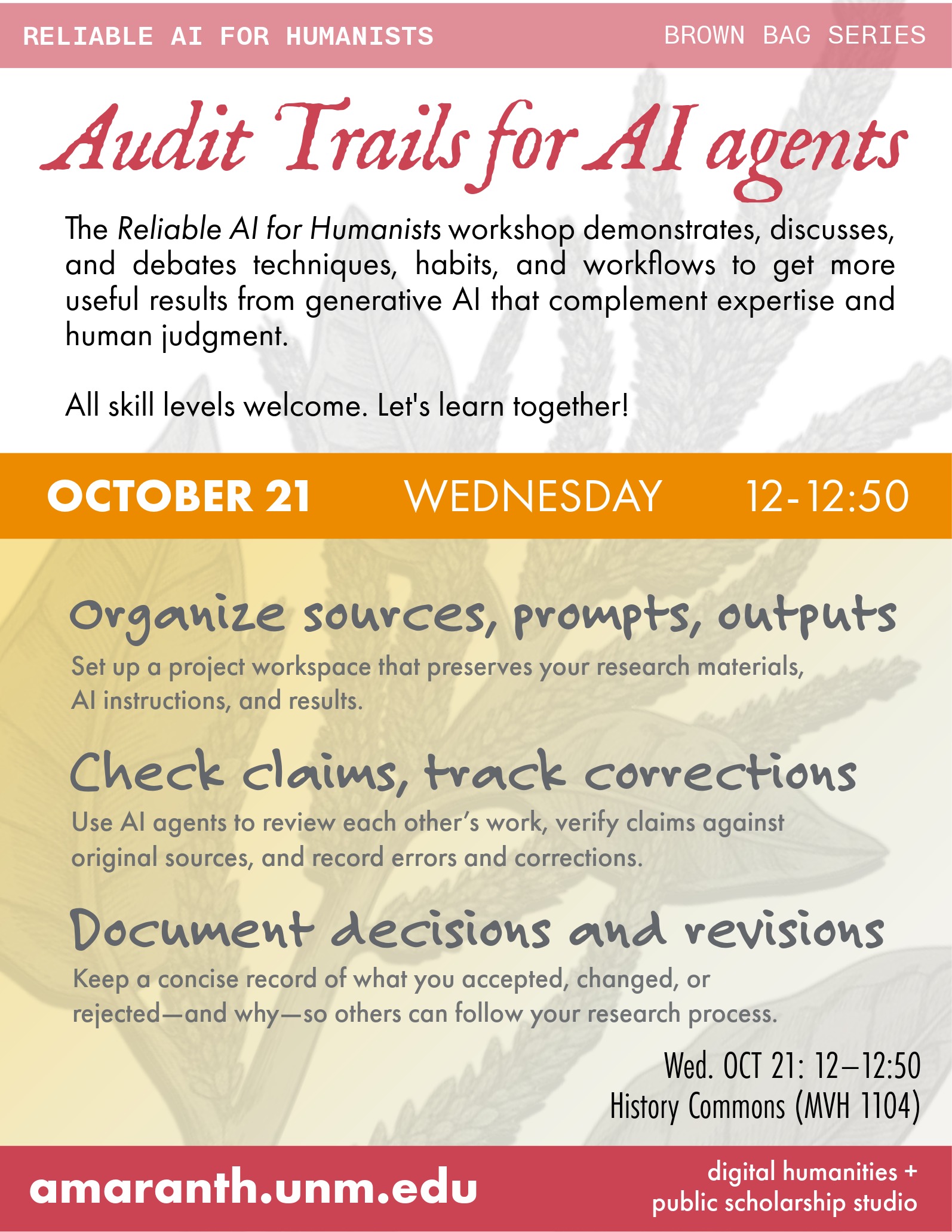
October 21 Wednesday 12:00–12:50 History Commons (MVH 1104)

Next week

Audit Trails for AI Agents

Read into a topic with an AI agent, map the articles’ ideas and relationships, and keep a record of what you checked and chose to read next.

  • Organize sources, prompts, outputsSet up a project workspace that preserves your research materials, AI instructions, and results.
  • Check claims, track correctionsUse AI agents to review each other's work, verify claims against original sources, and record errors and corrections.
  • Document decisions and revisionsKeep a concise record of what you accepted, changed, or rejected, and why, so others can follow your research process.

Bring a laptop and a topic to explore, or use the example we provide.
Later this semester

Past sessions

All sessions at a glance →

Hosted by Amaranth, a digital humanities and public scholarship studio at UNM.