Amaranth Brown Bag Series
Transcribing handwritten documents
Tips and recommendations
- Choose your tool based on your project needs
- Use one LLM to check the work of another
- Preview of agentic processing
Existing scholarship on HTR and AI
Several scholars are already working on this
- The field’s response. David Joseph Wrisley and Estelle Guéville, Medieval Manuscripts and the Computational Humanities (2026), ebook at UNM Libraries
- A plain guide to every option. Michael Schonhardt et al., Automated Text Recognition: Theory, Platforms, Best-Practices, ebook at UNM Libraries
- LLMs compared with Transkribus. Mark Humphries, generativehistory.substack.com
- Full transcription chats. Jonathan Seyfried, jonathanseyfried.net
Choosing the right tool
Match the tool to the needs of the project
- First, the language, age, rarity, and style of the handwriting.
- Second, the quality of the scan or photo, and its layout.
- Third, the number of documents you need transcribed.
- Fourth, the budget, time, and tech comfort you can bring to the project.
Then choose around 10 document images for a pilot test
Choosing the right tool
Try Transkribus live
- Choose a single image of a handwritten document with text in horizontal lines
- Drag the image into the box on the Transkribus home page
- Watch how it performs, with no additional setup required
Drag in an image and see what comes back. Need an example? Use Andrew Mauney’s diary.
Choosing the right tool
The usefulness of Transkribus depends on the script
If you have a document in Precalit Sanskrit or Old Nubian, you’re in luck! Someone else has created models for those.
For a Catalan document in late fourteenth-century Gothic Secretarial Hand, you are not lucky.
That said, a lot of scripts have existing models; almost all Latinate scripts from the nineteenth century will work on Transkribus.
Transkribus can be trained for a variety of layouts
Commercial LLMs
Train a model, or try a commercial LLM
If you have a script that is not yet available on Transkribus, you can train a new model
However, training a Transkribus model might not be worth the time, so instead you can try a commercial large language model
Generally, the AI chatbots will also work for Latinate scripts after 1900
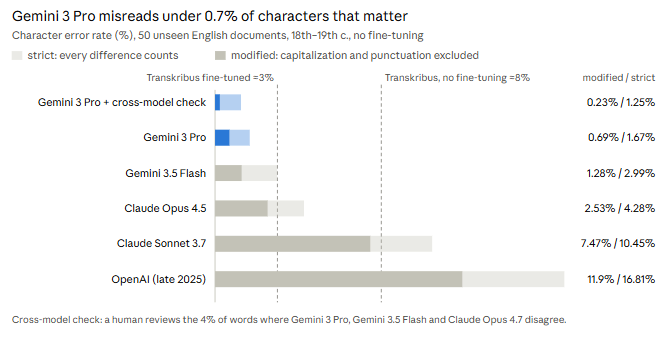
Table comparing transcription error rates for Gemini, Claude, and ChatGPT.
Photograph of classical Japanese handwriting on a silk handkerchief from the 1940s.
An example using Claude Fable 5.1
An unexpected success
Sometimes the LLM produces quite impressive results, as with this classical Japanese handwriting on a silk handkerchief from the 1940s.

Checking the transcription
Have a second model check the first
Current recommendation
- Use Gemini as the first LLM
- Gemini currently leads in performance for image recognition.
- Prompt Gemini
- Upload the image file and specify the year and the script.
- Then go to Claude
- Paste Gemini's output into this prompt for Claude.
Prompt for the second LLM
I am going to paste a transcription of the same image done by another LLM. Please look it over and use it to consider parts of the transcription that were ambiguous or difficult for you. Then make adjustments to your transcription and provide it again in full. Here is the transcription...It will take some time to check the end result for each document
Agentic AI
What agentic AI changes
- Agentic AI means letting an AI application edit files directly on your computer
- OpenClaw, the first popular agentic AI app, contained significant security vulnerabilities
- Today’s frontier agentic tools, such as Claude Cowork, are considerably safer
- The October 21 Reliable AI Brown Bag goes into agentic AI in more detail
Agentic AI
Batches instead of one by one
- Agentic AI can transcribe a whole batch of images instead of you uploading them one at a time
- Tried on document images from the Archive of the Crown of Aragon, with varying levels of success
- Batch output can go straight into a CSV, ready to open in Excel or upload as a database on a website
Two examples of CSV files are available on Jonathan Seyfried’s website
A section from the report generated by Claude about the agentic AI pipeline process.
Cautionary notes
Points to take with you
Image recognition drains usage credits quickly
There is a substantial time commitment for perfect transcriptions, increasingly viewed as a ‘verification tax’
Consider the use of AI for transcription as more of an axe than a scalpel
At the same time, be ready for the AI to surprise you with moments of high accuracy
More resources for HTR using AI
The webpage has the links and more detail
- The presentation slides
- Links to all the examples covered in the presentation
- A report on 2026 HTR developments generated by Claude
- Citations of current scholarship