Introduction
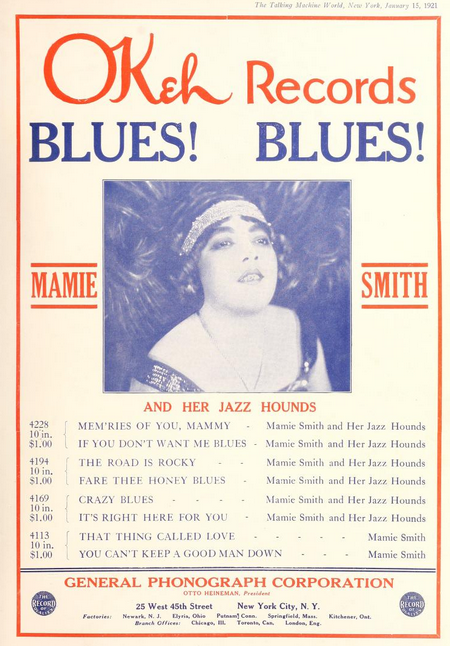
Mamie Smith’s “Crazy Blues” was a song that changed African-American music forever. It was the first blues song recorded by an African American woman in the United States. This was an important song because it ushered in race records and allowed music companies to see that there was profit to be made from black music like blues and jazz. This song was popular and launched Smith into stardom and a country-wide tour. “According to the shipping director at Okeh, 75,000 copies of “Crazy Blues” were distributed to Harlem record shops alone within the first 4 weeks after release.” (Gussow, 2)
Historical Context (1920s)
During the 1920s, citizens were immigrating north because many jobs were opening up due to the rapid industrial growth. This is The Great Northern Migration. During this time, the South was still recovering after the Civil War. Meanwhile, many industries were starting to boom, such as the meat factories in Chicago and the steel plants in places such as Detroit and Pittsburgh. Prohibition had just started and would last another 13 years. This was the result of a larger modesty movement that gained popularity across America in response to changing environments, like the massive number of immigrants coming to America. Prohibition was the result of a larger modesty movement that rapidly gained popularity across America. This was in response to the changing landscape of America, such as the rise of the factory, and especially the massive number of immigrants coming to America at this time, which these temperance movement people saw as ruining the well-being of America. Prohibition is extremely important and led to the rise of secret bars, where songs like this would definitely be performed. Blues and music in general were often a response to the conservative views of the prohibition era.
The Impact “Crazy Blues” Made
The Northern industrial economy is booming during this time due to new industries and economic opportunities. The great depression is not far away, but when this song came out, the economy was still doing very well, thanks to the rapid growth experienced across the North. The African American immigrants to the north now had money to spend, and wanted to spend it on music made by black artists. Mamie Smith filled this void, and her record became a best seller. I think this song combines rural and urban elements of African American culture, in a time when many African Americans were immigrating from the rural South to the urban North, a song like this would be very popular among people experiencing that. Leaving your home for somewhere new is never easy, and a song like this that talks about a forgotten love would relate to these people who might have left the ones they loved behind for better opportunities in the north. This song is about ideas that many people at the time might have been able to relate to. This was the first song recorded by a black woman, so many people, especially other black people, wanted to purchase and listen to this record, because it was the first song released by another black person. “Mamie Smith became known as the Colored Queen of Syncopation.” (The Gazette, Cleveland, Ohio.)The song became very popular in its time and ushered in the era of race records, as music producers realized the potential of music produced by black Americans.
What role did technology play in this song’s popularity?
Crazy Blues was one of the first songs ever recorded and put on radio stations, and the first song by a black woman to be recorded. This song became insanely popular due to the rise of radio across America. There was a huge demand for this song to be played/bought by the American public, especially by the African American community. With the rise of radio and mass communication, songs could travel across the country; they weren’t limited to the places and people that made them.
Technology’s Role in the Popularity of “Crazy Blues”
Crazy Blues was one of the first songs ever recorded and put on radio stations, and the first song by a black woman to be recorded. This song became insanely popular due to the rise of radio across America. There was a huge demand for this song to be played/bought by the American public, especially by the African American community. With the rise of radio and mass communication, songs could travel across the country; they weren’t limited to the places and people that made them.
What Makes Blues? What are Blues?
-What’s the time signature?
Almost all blues are in 4/4. Some blues is played in 6/8 but can still be 12-bar blues. Most blues songs will be 12-bar and played in 4/4 time, but you can also find 8-bar blues in 4/4, 16-bar blues in 6/8, and more.
-What defines the blues?
The blues is tough to define as it takes on many forms, but at its core, it is always in 4/4, following some sort of progression that stresses I, IV, and V chords, most commonly using Dominant 7 chords.
-What is the progression and type of music
The progression is traditionally a 12-measure repeated progression that utilizes the I, IV, and V chords (Usually the dominant 7). It begins with the I chord for 4 measures, followed by the IV chord for 2, and the I chord for 2 more, then 2 counts on the V chord and back to the I chord for 2 measures. This is called the 12-bar blues. There are other forms of blues other than 12-bar, including the less popular 8-bar blues, 16-bar blues, and 10-bar blues.
-How is the music structured?
The blues are traditionally built around the dominant 7, I, IV, and V chords in whatever key the artist is choosing to play.
- Is it coming from what traditions?
The blues come from the end of the slave trade, around 1809. (The Roots and Impact of African American Blues Music, Emily Weiler. parg. 2) This came from the singing of several different songs from different parts of Africa. A lot of these songs came from things like the spiritual, working, and ceremonies, but eventually the blues turned into songs about love, loss and retained its themes of the spiritual as well as working.
Crazy BLUES
Crazy Blues goes from variates from 12 bar and 16-bar blues progressions. As Jim Morrison said, “I like singing blues… where there’s no specific beginning or end. It just gets into a groove and I can just keep making up things. And everybody’s soloing.” (Jim Morrison, 1969) “Crazy Blues” has some parts in 12-bar, and some parts in 16-bar, while using syncopation
Mamie Smith-The Woman Behind it All
Mamie Smith, the woman who recorded “Crazy Blues,” is known to have sung a style of Blues with vaudeville elements. This incorporation of vaudeville style may be because Mamie began show business at age ten, starring in a group called the “Four Dancing Minstrels.” Other than this, not much is known about Mamie’s early life. So why did she record this song? It’s said that she recorded this to appeal to black audiences, showing they were a viable market for pop music. Women, in particular, were featured in popular music due to the rise of jazz and blues, which provided a platform for them at this time. Unfortunately, another reason black women were popular in this business is that they were seen as “easier to control” as opposed to men. As a result, music was one of the first fields to open up to women.
Her Lasting Impact
While some people think “Crazy Blues” is about a personal heartbreak, others argue that the song represents a broader experience of black women at this time. “Crazy Blues” is credited by some historians with catalyzing the proliferation of “race records” (records targeting an African-American audience). The rise of “race records” and technological advances in the 1920s spread blues music to audiences who wouldn’t have otherwise known it. Blues music had several influences, including work songs, minstrel show music, church music, as well as folk and popular music in white culture.
Bibliography
-Sources https://libproxy.unm.edu/login?url=https://www.proquest.com/iimpft/magazines/blues-forms/docview/198708589/sem-2?accountid=14613 The Roots and Impact of African American Blues Music by Emily Weiler (Whitworth University) https://www.rollingstone.com/music/music-news/the-rolling-stone-interview-jim-morrison-73308/
SMITH, ROGER. “In 1920, Mamie Smith’s Crazy Blues paved the way for Black music.” The Syncopated Times (2020) https://syncopatedtimes.com/in-1920-mamie-smiths-crazy-blues-paved-the-way-for-black
DOYLE, RODGER. “The Great Migration.” Scientific American 290, no. 2 (2004): 25–25. http://www.jstor.org/stable/26047584. https://blackpast.org/african-american-history/smith-mamie-1883-1946/ https://www.loc.gov/resource/sn83035387/1923-11-17/ed-1/?sp=4&q=Mamie+Smith&r=0.039,0.412,0.446,0.197,0 Gussow, Adam. “‘Shoot Myself a Cop’: Mamie Smith’s ‘Crazy Blues’ as Social Text.” Callaloo 25, no. 1 (2002): 8–44. http://www.jstor.org/stable/3300383.