Generate 3D Prints from 2D Drawings
- Experiment
- We used historical drawings of IUDs to try making 3D-printable replicas with Meshy.
- What I learned
- line drawings gave closer-looking results than our earlier photograph experiments
- a printable model still needs comparison with the historical source
- Results
- generated printable models from historical drawings
- found that Meshy could smooth away asymmetries in a source
- You'll need
- Meshy.ai
- Format
- 30–60 min
- Jig by
- Fred Gibbs, History
History doctoral candidate Edrea Mendoza studies public health and sex education initiatives in 1970s Mexico. Her research turned up drawings of IUDs manufactured during that decade as part of a government push for population control. She wanted replicas she could hold. We tried turning the drawings into printable models with Meshy.ai.
From drawing to model
Meshy takes an uploaded image, generates a 3D mesh, and exports a file for printing. That let us try the drawings without first building the models by hand.
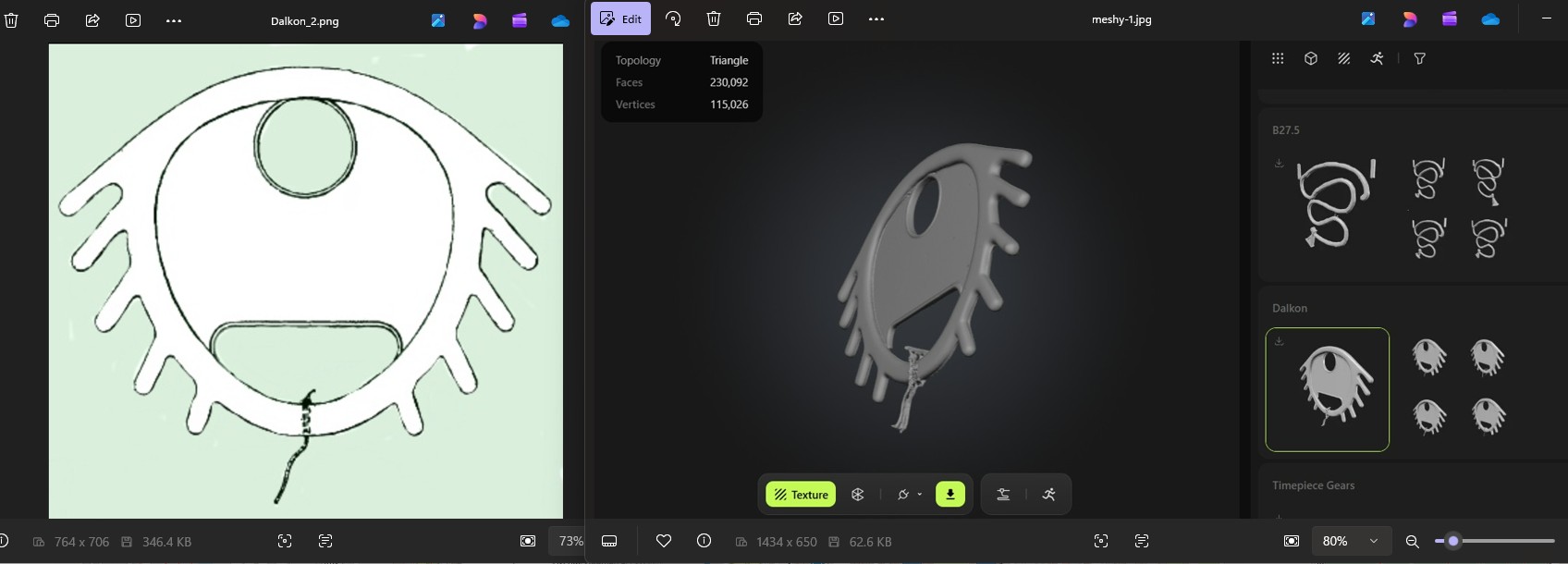
A 2D IUD drawing uploaded to Meshy.ai.
What the tool changed
Earlier Meshy experiments at Amaranth with high-resolution photographs of museum objects had produced distorted results, even with multiple views. The line drawings gave us models that appeared closer to the sources.
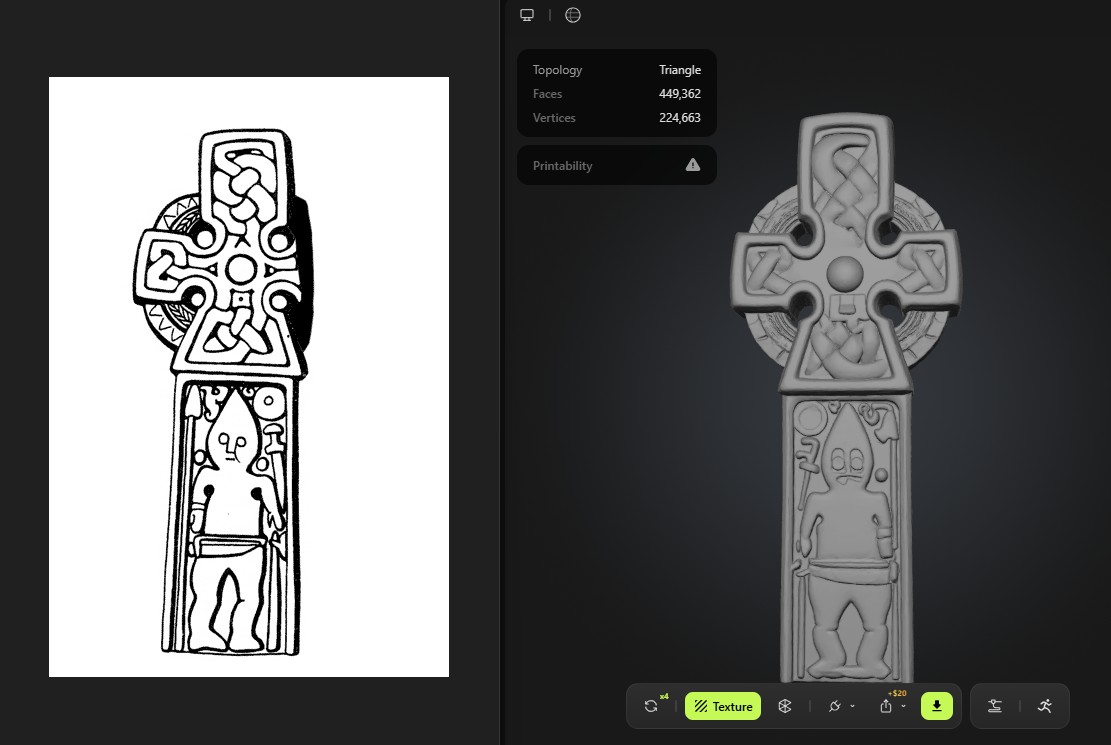
Screenshot of what Meshy.ai produced for a Middleton Cross.
One result showed why that comparison matters. When we uploaded a drawing of a Middleton Cross, Meshy smoothed and regularized asymmetries in the original. It treated features we wanted to preserve as imperfections to correct. A model can look convincing while losing exactly the details a researcher cares about.
What the replicas are for
Holding a replica offers a different way to discuss an object in a research presentation. It also makes the reconstruction’s limits worth explaining. A printable file doesn’t establish the accuracy of its dimensions or the parts of the object the drawing doesn’t show.
These experiments make me interested in trying other artifact illustrations and diagrams. I’d assess each result against its source before deciding what claims the replica could help support.
Using This Experiment
This experiment is licensed under Creative Commons BY-NC-SA 4.0. You're welcome to share and adapt it for noncommercial purposes, with credit, as long as you share your adaptation under the same license.
Suggested citation
Fred Gibbs. "Generate 3D Prints from 2D Drawings." AI Workbench, Amaranth, University of New Mexico, April 9, 2026. https://amaranth.unm.edu/ai-workbench/research/meshy.html. Licensed under CC BY-NC-SA 4.0.