Incense in the Floating City
In Medieval Venice and indeed in most Medieval cultures with dualistic faiths, good scents were associated with the divine while bad scents were associated with the diabolic or evil. As such, Medieval peoples used incense in a variety of global religious contexts for the goal of creating and maintaining sacred space. Temples, cathedrals, synagogues, mosques, and other religious spaces often burned incense to create a holy sensory experience that worked in tandem with works of elaborate religious art and architecture. This was certainly the case in Venetian churches, though many Venetians, primarily elites, used incense within the sacred spaces of their own homes to create a peaceful and pleasant atmosphere from which they could pray and offer devotion to God.
Incense and Brass
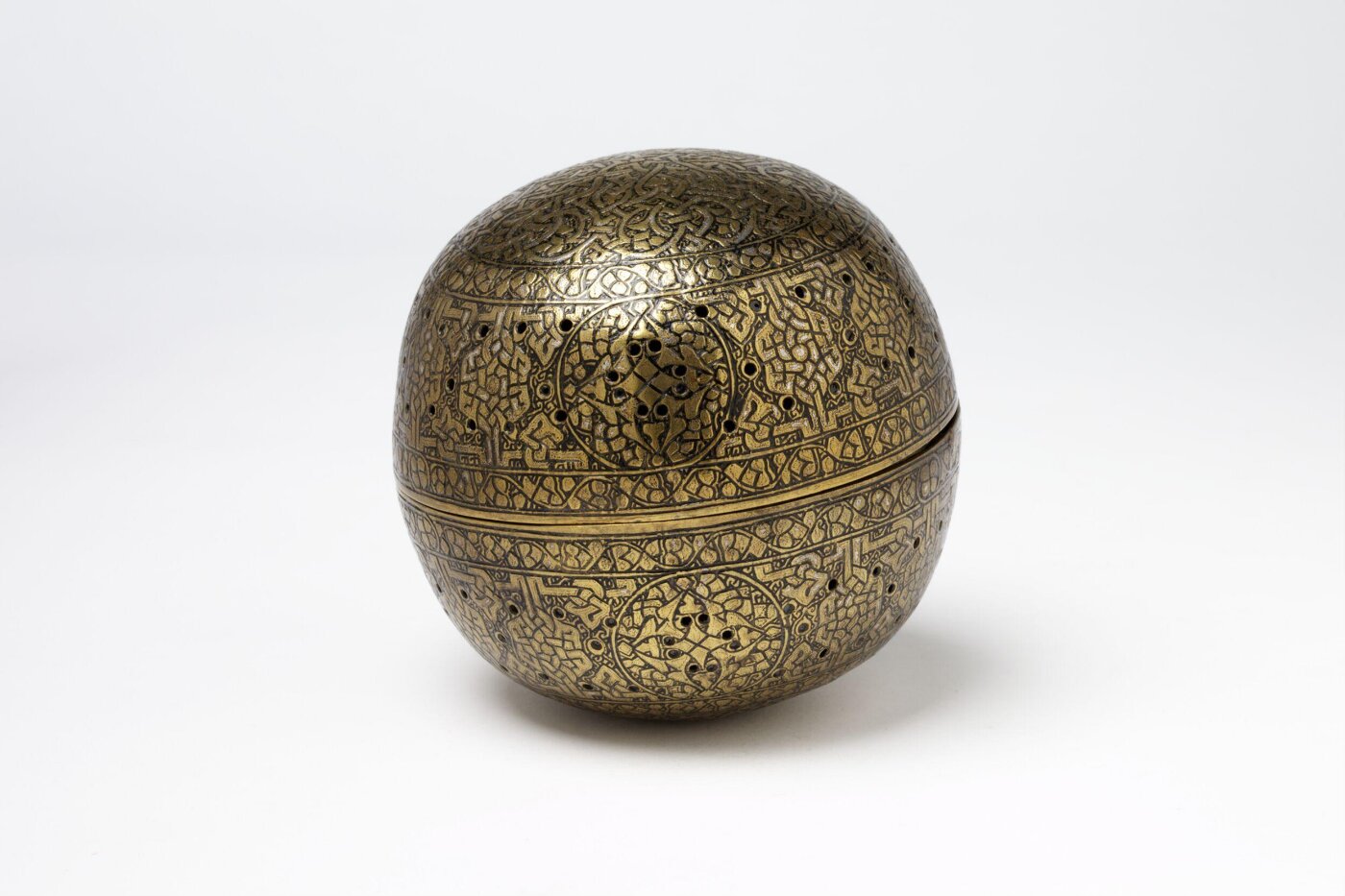
Unknown. Perfume burner. c. 1450-1500. Brass, pierced, engraved and silver damascened with black lacquer infill, 11.8 cm. x 12 cm. Victoria and Albert Museum, London.
However, burning incense can be messy as the ashes can easily scatter with the slightest breeze. As such, incense enjoyers in the Middle Ages often purchase incensed burners like this to control the mess while also providing a full and evenly distributed scent throughout a space. Brass incense burners such as this were popular status symbols for elite Venetians to show off their wealth while also having its practical uses. This incense burner, made in the late 15th century, features a network of elaborate engravings in black lacquer one might typically associate with Islamic art styles, but this was made in Venice by an anonymous member of the tinsmiths and pewterers guild. Nonetheless, it resembles brass incense burners like those made in the 13th century in Mamluk Damascus.
Venice and the Global Incense Trade
The incense itself, however, was not made in Venice and would have likely come from Syria, Egypt, Persia, India, or East Africa. Nonetheless, in the Middle Ages, Venice came to be a major broker in the incense trade in Europe as its merchants brought large quantities of incense from the ports of Alexandria and Syria to sell in the markets of the Rialto. Further, Venetian apothecaries became renowned for distilling incense oils into lotions, balms, and perfumes which were also sold in the Rialto. As such, the incense trade, though not a Venetian industry, inspired and fueled other Venetian industries like the medicinals industry and brass industry.
Conclusions: Venice, Incense, and Industry
Indeed, Venice’s engagement in Silk Roads trade and commerce allowed them to bring Eastern goods to their markets in Europe while also developing their own industries to supplement the sale of those commodities. Consumers not only desired the pleasant scents of incense, they also desired intricate metalworks to aid the burning of incense and incense-derived topicals so they could smell good themselves in addition to their markets, churches, and homes. Through the incense trade and its associated industries in Venice, the floating city added a dimension to its already ravishing sensory experience.
Bibliography
- Hoffman, Eva R. “Christian-Islamic Encounters on Thirteenth-Century Ayyubid Metalwork: Local Culture, Authenticity, and Memory.” Gesta 43, no. 2 (2004): 129-142.
- Morse, Margaret A. “Creating sacred space: the religious visual culture of the Renaissance Venetian ‘casa.’” Renaissance Studies 21, no. 2 (2007): 151-184.