The Standing Archer
Standing archers from the Terracotta Army are approximately 1.78 meters tall and are depicted in a dynamic firing stance, with one leg bent, feet positioned in a stable T-shape, and arms extended as if drawing a bow. They wear light clothing or minimal armor, emphasizing mobility and speed rather than heavy protection. Found primarily in Pit 1 and Pit 2 near Xi’an, these figures were positioned at the front lines, reflecting Qin military strategy focused on long-range combat and rapid response.
Brief Information
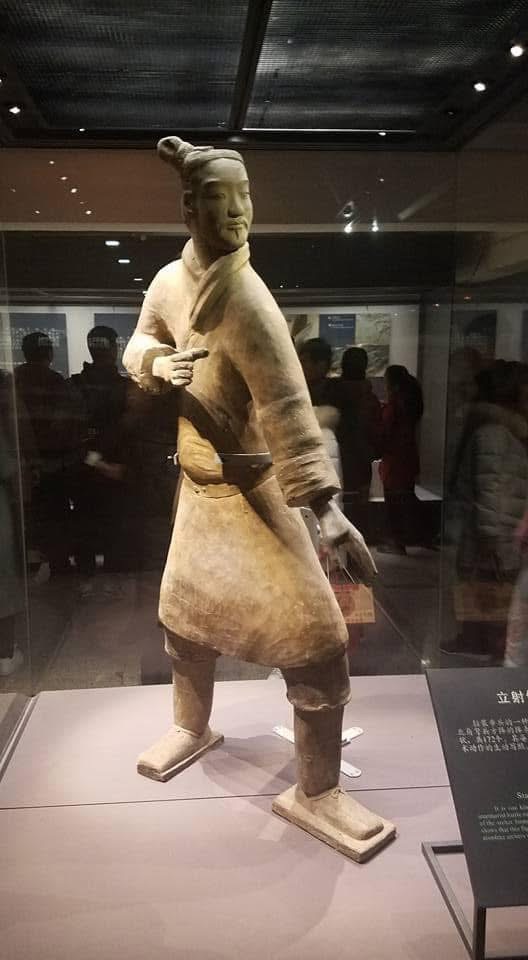
This is a photo taken at the Emperor Qinshihuang’s Mausoleum Site Museum. Xian, China. Source: Author Photo.
What makes the standing archer especially significant is the balance between individuality and standardization. Each figure displays subtle differences in facial features, hairstyle, and expression, yet the bodies were produced through a system of molds and modular construction. As Lukas Nickel explains, this method allowed for efficient mass production while still maintaining the appearance of individuality.^1 This reflects the Qin state’s broader emphasis on order, control, and the ability to coordinate large-scale production across the empire.
The tactical role of the standing archer also reveals important aspects of Qin military organization. Lightly armored soldiers were essential for maintaining flexibility on the battlefield, allowing for quicker movement and more effective ranged attacks. Unlike heavily armored infantry, archers could reposition rapidly and respond to changing conditions, suggesting that the Qin military valued adaptability alongside discipline. Their placement at the front of formations indicates their role in initiating combat, weakening enemy forces, and creating opportunities for heavier units to advance.
This emphasis on flexibility also reflects the broader priorities of the Qin state, which relied on coordinated movement and rapid response across its expanding territory. Military units had to function efficiently within a larger system, just as the empire itself depended on standardized communication and infrastructure. The standing archer therefore represents not only a battlefield role, but also the administrative logic that sustained Qin rule.
For a Silk Road project, the standing archer is significant because it represents the military and political foundations that made long-distance exchange possible. Qin Shi Huang unified rival states, standardized roads, weights, measures, and military systems, and established centralized control. According to Lucía Martín and others, the organization seen in the Terracotta Army reflects broader systems of governance and coordination.^2 This level of stability later enabled safer travel routes, which were expanded under the Han dynasty into what became the Silk Road.
The standing archer, therefore, symbolizes more than a single soldier. It represents a system of discipline, production, and military organization that helped create the conditions for sustained interaction across Eurasia.
Footnotes
- Lukas Nickel, “Building the Terracotta Army,” Antiquity 91, no. 358 (2017): 966–79.
- Lucía Martín et al., “Marking Practices and the Making of the Qin Terracotta Army,” Journal of Anthropological Archaeology 43 (2016): 1–22
Bibliography
Martin, Lucía, et al. “Marking Practices and the Making of the Qin Terracotta Army.” Journal of Anthropological Archaeology 43 (2016): 1–22.
Nickel, Lukas. “Building the Terracotta Army.” Antiquity 91, no. 358 (2017): 966–79.