Introduction
“Truth is your branch, joy is your leaves, love is your fruit, the eternal Living Self. Now, my God, I have seen you. I will not die! You are like the eternal light and living tree.”
- Manichaean-Turkic fragment (SI6621), near Turfan. 1
In the late ancient and medieval world, during the rise of Christianity, but before and during the origins of Islam, rose a unique religion that spread far along the trading routes modern scholars would deem ‘The Silk Road’. This creed was called Manichaeism, after its founder Mani, a 3rd-century prophet hailing from Sassanid Mesopotamia. It presented itself as the final and most truthful religion, the true and ultimate answer from a long line of prophets of surprisingly different backgrounds: Zoroaster, the traditional founder of Zoroastrianism (and the state religion of Mani’s home), Siddhartha Gautama, the Buddha, the traditional founder of Buddhism, Jesus Christ, the central figure of Christianity, and Mani himself. Mani drew from these faiths, amongst others– he was raised in a sect known as the ‘Alchasaitics,’ also known as the Elcesaites, a Jewish-Christian sect with gnostic leanings, but influences from these other ‘prophets’ can also be found in the new religion’s central teachings.2 For example, the radical dualism of Zoroastrianism, where the world is locked in an eternal epic battle between opposing forces of good and evil, or themes of light, the transmigration of souls and the structure of the Buddhist sangha (the “Elect,” who guide the lay followers, the “Hearers,”) from Buddhism. Similar to one of its inspirations, Christianity, it was also a universal missionary religion, that sought converts and acceptance across the world, believing its teachings to be the most orthodox and true. Within decades, it had spread west to the far reaches of the Roman Empire, and to the East, finding much popularity in the diverse Buddhist communities of Central Asia and China, its adherents called Manichaeans, or Manichees. Whether it was its message of salvation by siding with the true, uncorrupted light, its foundation relying on other, often familiar religious traditions and ideals, its persistent missionary activity, its splendorous art, or a combination of these, Manichaeism emerged as a major rival to Christianity in late antiquity, and spread and endured for many centuries across the Silk Road trading network.
Buddhist Influence
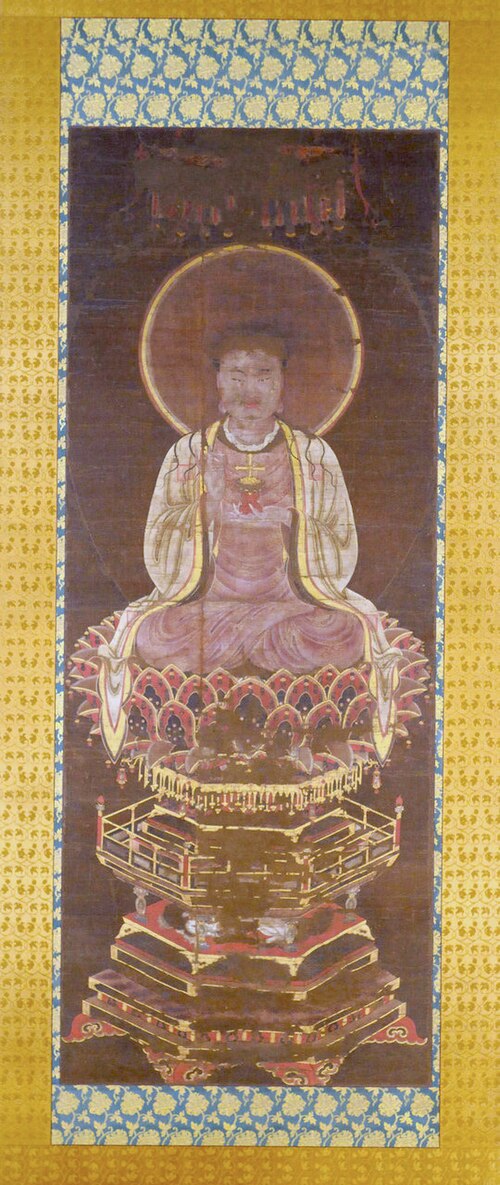](/silk-road//essays/light/images/buddhajesus.jpg)
Sacred Image of the Buddha (Prophet) Jesus. Source

While Buddhism may not have had a major presence in Mani’s home region, it was in the Buddhist-majority regions of Central and East Asia where Manichaeism took its greatest root, and indeed persisted the longest. Perhaps it was because these regions were already used to syncretism– in Sogdiana, the eastern reaches of Iranic culture and influence, syncretism was commonplace: local polytheistic gods were worshipped with even deities of Greek or Mesopotamian background, alongside Buddhist schools of thought adoring the locals with their own philosophies and beliefs. People were used to travellers and missionaries, and this was a common sentiment amongst the Buddhist world of Central Asia. Where Buddhism had blossomed after leaving India along the Silk Road, Manichaeism followed much of its footsteps, traveling from Persia across Asia into China. While many Buddhist authorities found the faith as heretical, Buddhism was different from the organized institution that Christianity had formed, and it was perhaps due to this lack of central authority that the religion gained sympathy amongst people. However, while the faith had its ardent followers, it never truly found official state support, something crucial for any religion if it wishes to not only survive, but thrive and endure. During its evangelizing mission, Manichaeism finally found a brief success in converting Bogu Kaghan, the ruler of the Uyghur Khaganate, perhaps as a way to signify its cultural independence from its powerful neighbor, the Buddhist-influenced Tang Dynasty. Unfortunately, the ruler was killed in a conspiracy by his uncle, who then suppressed the religion and its adherents. It gained some prominence after his own demise, before the Khaganate collapsed to war. However, despite losing state support, Manichaeism endured in the area, and much of surviving artifacts related to it were found alongside Buddhist ones in the sealed caves and libraries littered across the region. [^Gulacsi, Artibus Asiae, p. 96] Artistic Buddhist influence is also seen in surviving Manichaean art– with the exception of the Sealstone of Mani and some religious literature, all surviving Manichaean art is Asian in origin, and tends to have glaringly obvious Buddhist themes– haloes, hand mudras, lotus thrones, paradise imagery, and general resemblance to contemporary portraits of sacred Buddhist figures such as bodhisattvas. The few surviving Manichaean portraits and representations of prophets can easily be mistaken for such Buddhist figures. The few surviving Manichaean portraits and representations of prophets can easily be mistaken for such Buddhist figures.3 4
Western Influence
](/silk-road//essays/light/images/maniseal.jpg)
Sealstone of the Prophet. Source

Mani’s native language was Syriac, a popular lingua franca of late antiquity. This was the language ancient Christianity used to proselytize those who were not of Greek or Latin background, a language active across the broader Middle East. In the Christian fashion, it was adopted as a liturgical language for the churches that spread eastward, and was used frequently by traders alongside that part of the world. It was adopted similarly for Manichaeaism: of the seven great works by Mani, six were written in Syriac, the last in Middle Persian. In what is presumed to be Mani’s official sealstone, the declaration of his successorship to Jesus Christ is also in Syriac. Another common language of the era was Koine Greek, which served as a lingua franca of the Mediterranean world, even following the Roman conquests. It was the most common language used by Christians, and so Manichaeans often adopted and used it to further their own agendas against their religious rivals. Alongside Greek, Coptic too was adopted, popular in Egypt, a base of influence for the western branch of Manichaeism. Many surviving religious documents today are in these languages, almost certainly translated from Syriac, found in deposits in Egypt. Seeing how it is these documents that survived in the Mediterranean world, it can be inferred how serious the evangelizing effort was on both ends of the Silk Road.5
Survival by Art
](/silk-road//essays/light/images/manipainting.png)
Mughal-era depiction of Mani painting a dead dog. Source

Curiously enough, aside from his status as the founding prophet of a once-major world religion, Mani was also greatly renowned in his legacy as a painter. He was convinced that the only way his divine revelations could be conserved, without being misunderstood or corrupted by his successors, was to have it in writing. Surviving fragments speak of his prolific writing– the Manichaean canon was composed of both his own creations and works of other sources, such as the Book of Giants, remnants of which have been observed in the Dead Sea Scrolls, but one of the central holy books of the faith was known as the Arzhang (“Worthy”), or the Book of Pictures, written and illustrated by Mani’s hand. Mani himself, in the Kephalaia (‘Chapters’ in Greek, said to be the sayings of the prophet, similar to the hadith tradition that recounts the prophet Mohammad’s statements) states how art is necessary to establish true legitimacy: “Indeed, all the (apostles), my brethren who came prior to me: (They did not write) their wisdom in books the way that I, I have written it. (Nor) did they depict their wisdom in the pictures the way (that I, I have) depicted it. My church surpasses 30 (in this other matter also), for its primacy to the first churches.” 6 Art is also the largest corpus of evidence for Manichaeism’s extinguished prominence. Many other sects and religions that too held gnostic orientations and backgrounds are only known today by name only (especially until the discovery of the Nag Hammadi library), often mentioned in adversarial polemics from the religions that found success and endured time– Christianity, Islam, Buddhism. Until major archeological excavations in Central Asia and what is today Xinjiang, spearheaded by figures such as Aurel Stein, Manichaeism in the West was only remembered as a fleeting group of heretics, mentioned by prominent Christian writers such as Augustine of Hippo and Ephrem the Syrian. Today, much artwork has been established by scholars to be of Manichaean origin, ranging from an array of murals, silk portraits, letters, illuminated manuscripts, banners, and more. As the Manichaean Church vanished in the Islamic World (from Roman, where it was extirpated soon after the state’s formal adoption of Christianity, to caliphal and Islamic persecution, church infighting and factionalism, migration and establishing itself in Yuan China, and other reasons), Mani’s fame endured as a renowned painter, rather than for his prophetic status. 7 His story was remembered and recorded– he is described as a false prophet and illustrious “image-maker,” in conflict with the Zoroastrian clergy of the pre-Islamic period, in Ferdowsi’s Shahmaneh, an epic poem of paramount status in the Persianate world. 8 There exist many medieval Islamic depictions of Mani either painting, presenting his work to the Sassanian emperor, and even of his execution (there are different accounts of the prophet’s martyrial, violent end; hanging, flaying, beheading). This fame of his artistic talent ultimately survived his church, by the time the last remnants of his followers assimilated to Buddhism in China, he was still known for his skill as a painter, even in the early modern Safavid and Mughal worlds.
Bibliography
- Zieme, Peter. (2019). Notes on a Manichaean Turkic Prayer Cycle. Written Monuments of the Orient. 5. 3-11. 10.17816/wmo25863-.
- Sundermann, Werner. “MANI.” Encyclopaedia Iranica. Published July 20, 2009. https://doi.org/10.1163/2330-4804_EIRO_COM_940
- Gulácsi, Zsuzsanna. “A Manichaean ‘Portrait of the Buddha Jesus’: Identifying a Twelfth- or Thirteenth-Century Chinese Painting from the Collection of Seiun-ji Zen Temple.” Artibus Asiae 69, no. 1 (2009): 91–145.
- Gulácsi, Zsuzsanna. Mediaeval Manichaean Book Art: A Codicological Study of Iranian and Turkic Illuminated Book Fragments from 8th–11th Century East Central Asia. Leiden: Brill, 2005.
- Yoshida, Yutaka. “Conférence de M. Yutaka Yoshida : Manichaean Sogdian Letters Discovered in Bāzāklik.” Annuaire de l’École pratique des hautes études, Section des sciences religieuses 109 (2000–2001): 233–236..
- Koenen, Ludwig, and Römer, Cornelia. eds. The Cologne Mani Codex (P. Colon. inv. nr. 4780): “On the Origin of His Body.” Corpus Fontium Manichaeorum. Universität zu Köln, 1988.
- Gulácsi, Zsuzsanna. “The Prophet’s Seal: A Contextualized Look at the Crystal Sealstone of Mani (216–276 CE) in the Bibliothèque nationale de France.” Bulletin of the Asia Institute 24 (2010 [2014]): 161–185.
- Gardner, I., & Lieu, S. N. C. (Eds.). (2004). Manichaean Texts from the Roman Empire. Cambridge University Press.
-
Zieme, Peter. (2019). Notes on a Manichaean Turkic Prayer Cycle. Written Monuments of the Orient. 5. 3-11. 10.17816/wmo25863 ↩
-
Koenen, “On the Origin of His Body.” p. ix ↩
-
Gulacsi, Artibus Asiae, p. 102 ↩
-
Gulacsi, MMBA, p. 204 ↩
-
Gulácsi, Zsuzsanna. “The Prophet’s Seal,” p. 170 ↩
-
Gardner, Manichaean Texts from the Roman Empire, p. 266 ↩
-
Sundermann, “MANI.” Encyclopaedia Iranica ↩
-
Gulacsi, MMBA, p. 180 ↩